The Lock-In Protocol: Reclaiming Your Attention in a Distracted World.

DISCLOSURE: THIS POST MAY CONTAIN AFFILIATE LINKS WHICH MEANS WE MAY RECEIVE A COMMISSION IF YOU CLICK A LINK AND PURCHASE SOMETHING. PLEASE CHECK OUT OUR DISCLOSURE POLICY FOR MORE DETAILS.

Table of Contents

Your Morning Set Up The Tone Of The Entire Day

There is a quiet crisis unfolding in modern life—one that does not announce itself with urgency, but reveals itself slowly, at the end of long weeks, when you look back and wonder where your time disappeared.

You had goals.
You had ambition.
You had clarity.

And yet somehow, the days dissolved into fragments.

Not because you lacked vision—but because your vision was never protected.

In the modern attention economy, nothing is neutral. Every notification, every scroll, every message, every ā€œquick checkā€ is part of a larger system competing for the most valuable resource you possess:

āš—ļø Your attention.

And attention is not just a mental function. It is the raw material of your life. Everything you build—your skills, your income, your body, your relationships, your future—is constructed from what you consistently focus on.

The uncomfortable truth is this:

While you are living your life, entire industries are engineered to capture it.

Platforms are not designed to serve you. They are designed to hold you. A few extra seconds of your gaze is not accidental—it is monetized. And while companies convert your attention into profit, you may be unknowingly paying with something far more expensive than money.

You are paying with momentum.
You are paying with depth.
You are paying with unfinished potential.

Most importantly, you are paying with distance—the growing gap between who you are and who you could have become.

āš—ļø Someone will profit from your attention. The only question is whether it will be an algorithm—or your future self.

āš™ļø The Real Problem Is Not Motivation—It Is Access

Most people misdiagnose their lack of focus as a motivation problem. They assume they need more discipline, more inspiration, more willpower.

But the truth is far more structural.

They are trying to focus in environments that are actively designed to fracture focus.

A phone within reach.
Notifications enabled.
Multiple tabs open.
Messages arriving constantly.
No boundaries.
No system.
No separation between work and distraction.

In such conditions, focus is not difficult—it is statistically unlikely.

Because the brain does not choose long-term reward in an environment saturated with immediate stimulation. It defaults to what is easiest to access.

And if everything has access to you, then nothing truly has priority.

āš—ļø Locking in is not about trying harder.
It is about designing reality so that distraction becomes inconvenient—and meaningful work becomes inevitable.

🜁 Focus Is Not Willpower. It Is Architecture.

You do not rise to your goals each day. You return to the systems surrounding you.

Without structure, every moment becomes a negotiation between what matters and what feels easier.

This is why so many intelligent, capable people drift through their days. They delay work, check their phone, respond to messages, and tell themselves they will begin later—until later becomes tomorrow, and tomorrow becomes a pattern.

Over time, emotion begins to govern execution.

And execution determines everything.

Focus requires architecture:

  • A defined time to work

  • A defined space to work

  • A defined objective

  • A defined starting ritual

  • Defined rules around distraction

  • Defined measurement of output

When structure is absent, every task becomes a debate.

When structure is present—

āš—ļø The decision is already made.

šŸœ‚ The Lock-In Period: Choosing One Reality

Transformation does not begin with more goals. It begins with fewer.

Choose a defined period—7, 30, or 90 days—where one objective becomes disproportionately important.

Then ask the only question that matters:

āš—ļø If I completed only one thing in the next 30 days, what would change my life the most?

Not ten goals. Not five priorities. One.

  • Launch the business

  • Finish the book

  • Build the product

  • Pass the exam

  • Develop the skill

  • Change your financial trajectory

Then accept a difficult truth:

During a lock-in period, everything cannot be equally important.

Your dream cannot remain priority #17 and still expect priority #1 results.

🜃 The Distraction Firewall

Willpower is not a system. It is a temporary state.

So instead of relying on it, you design your environment to enforce focus.

  • Turn off unnecessary notifications

  • Remove your phone from reach

  • Block distracting websites

  • Close irrelevant tabs

  • Log out of habitual apps

  • Prepare your workspace before starting

Make distraction inconvenient.
Make execution obvious.

At first, this feels restrictive.

But so does a boundary around a fire—until you realize it is what allows the fire to exist at all.

āš—ļø You would not allow strangers to interrupt you every three minutes.

Yet that is exactly what an unprotected digital environment does to your mind.

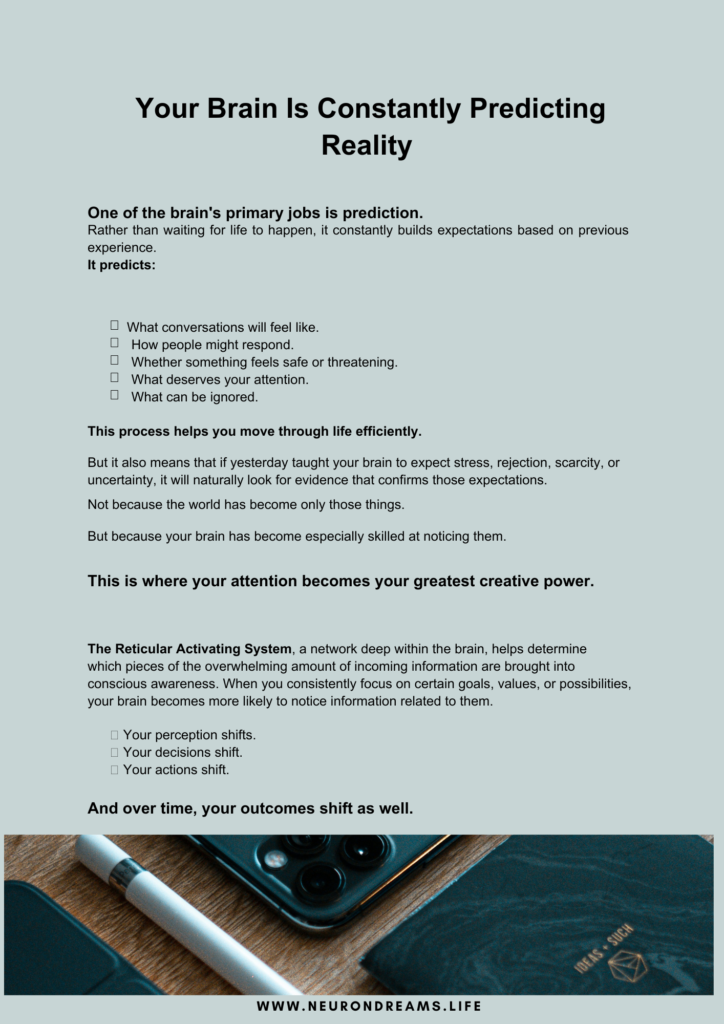
What you pay attention to affects your later thoughts, your feelings, and your behaviors. In other words, you act based on how you feel and you feel based on how you think, or more precisely, what thought you choose to think. Because believe it or not, you can always decide what thought you want to feed and what you prefer to abandon. You truly control the narrative on every single level, even if you’re doing this unconsciously.

Thus, if you want to live your best life, you should avoid (or REDUCE) negative information, toxic people, other people’s drama, self-limiting beliefs, bulls*it thoughts that can only make you feel awful, powerless, and hopeless.

As Tony Robbins says, where focus goes energy flows. In other words, if you want to become the best version of yourself and turn your dreams into reality you need to control your focus.Ā 

So the real question is what kind of reality do you want to create for yourself: a positive or negative one?

Because if you want to create a positive reality for yourself you should focus on positive things and stay away from broadly defined negativity. However,Ā if you prefer to live in the constant negativity you should do the exact opposite which is consuming negative/toxic content and actively avoiding positive inspiration.

Stay out of things that do not concern you. Don’t waste your time, energy, and attention on things or people that do not bring value to your life. Instead redirect your focus on yourself, on your top priorities, and on what’s the most valuable in YOUR life.

  • create your focus list
  • study the right type of content that helps you meet your goals
  • go on a strict content diet (consciously choose to “consume” positive content and avoid negativity)
  • unsubscribe and unfollow the people who don’t bring value into your life
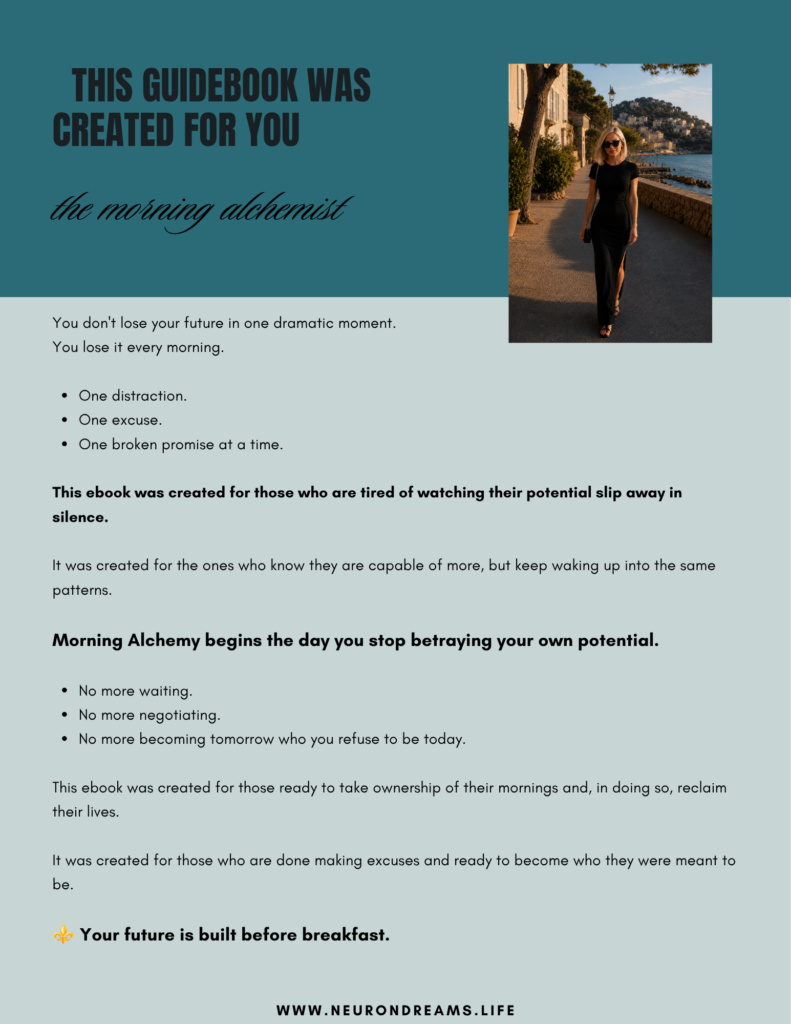
šŸœ„ The First Hour Determines the Day

One of the most expensive habits in modern life is this:

Giving the world access to your mind before you have decided what your mind is for.

You wake up.
You reach for your phone.

And suddenly:

Messages.
Emails.
Social media.
News.
Other people’s lives.
Other people’s crises.
Other people’s opinions.

Within minutes, your attention is no longer yours.

āš—ļø You have not even left your bed—and your most valuable cognitive resource has already been distributed to the world.

This is why the morning matters.

Not because of aesthetics.
Not because of productivity trends.
Not because of ā€œsuccessful people routines.ā€

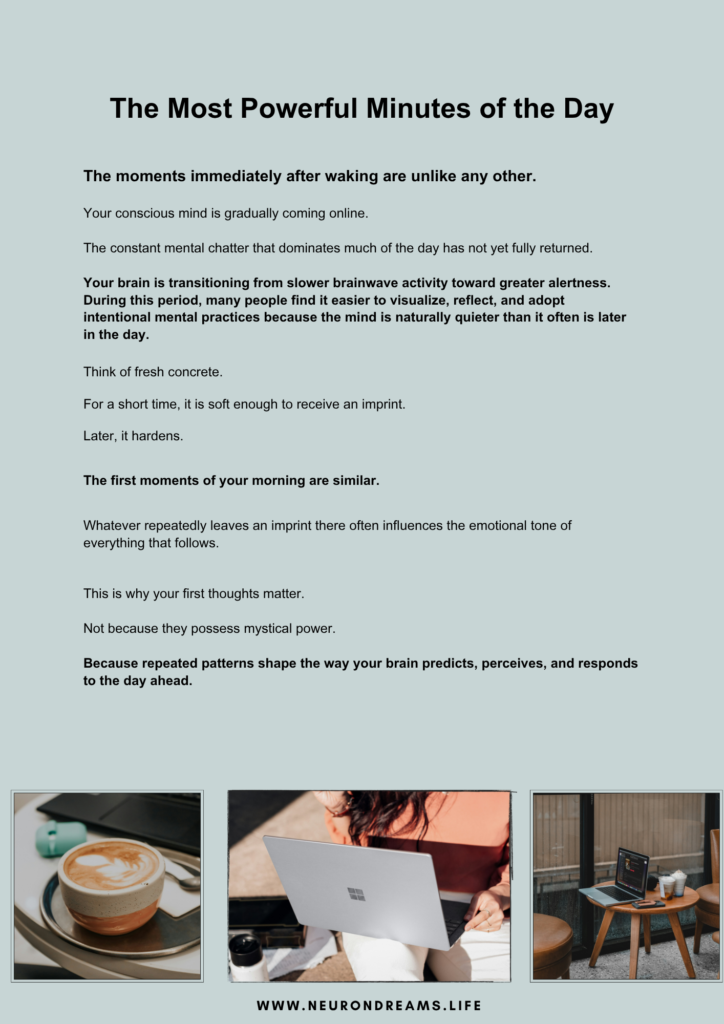
But because the morning is the only time that still belongs to you.

Before demands.
Before noise.
Before fragmentation.

There is a window where attention is still unclaimed.

And what you do in that window determines everything that follows.

Create before you consume.
Think before you react.
Decide before the algorithm decides for you.

Move your body.
Stabilize your nervous system.
Define your intention.
Enter deep work before distraction enters you.

āš—ļø This is not a morning routine.

It is identity formation.

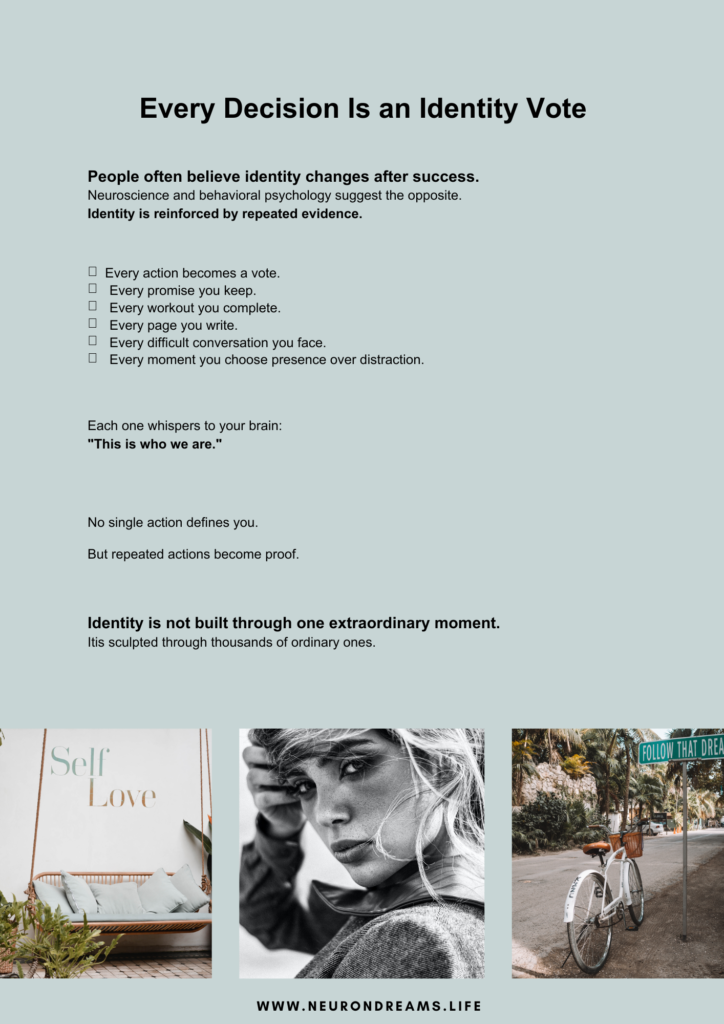
Every morning is a vote.

One vote says: I am reactive.
Another says: I am intentional.

And identity is simply the accumulation of votes you stop noticing.

Over the years through working on different projects I learned that one of the best and easiest ways to build momentum is to start before you’re ready, start before the fear of failure kills the creativity. Instead, build momentum by consciously and deliberately putting yourself in motion. Make the first step in the right direction, achieve this heavy sense of concentration, make your motivation flow effortlessly and start creating real results.Ā 

Stop negotiating with yourself, instead, eliminate all external and internal distractions, put on the right kind of music (I usually listen to mindfulness music for deep focus and concentration with binaural beats), and start working towards achieving your goals. Enter into that hypnotic state where creativity flows effortlessly and achieve what you thought was impossible.Ā 

šŸœ” BEFORE THE WORLD WAKES

Another golden rule of strict mental dieting is toĀ switch your What-ifs from negative to positive. This may seem obvious but when it comes to starting new projects, trying new things, and challenging your status quo your brain is doing all it can to make up as many worst-case scenarios as possible. And the funny thing is that it is doing it to protect you from potential risk.Ā 

All of a sudden, at one time, your goals become unattainable, your vision extremely distant and excitement turns into anxiety. And as a result, you get stuck and can’t move forward.

The way to avoid becoming paralyzed by the worst-case scenario and take action on your goals is to realize that the human brain is designed to keep us (humans) safe, comfortable, and relatively bored. Hence, the worst-case scenarios are aimed at stopping us from taking (potentially risky) action. We’re not supposed to take any risk, even a calculated one because that would cause an increase in our cortisol levels and cause a potential danger to our health.

The reason for that is simple: the human brain doesn’t know the difference between challenging yourself to reach your goals and putting yourself in dangerous situations. Fortunately, your conscious self knows that difference. So when your brain tries to stop you from succeeding you need to take charge and make a conscious shift from ā€œwhat’s the worst that can happenā€ to ā€œwhat’s the best that can happenā€. In reality, your outcomeĀ is almost alwaysĀ somewhere in between.

šŸœ The Focus Ritual

Deep focus is not summoned. It is entered.

And entry becomes easier when the path is always the same.

  • Same workspace

  • Same starting sequence

  • Same environmental cues

  • Same intention written down

  • Same transition ritual

Over time, your mind learns a simple equation:

āš—ļø When this sequence begins → we work.

This is how discipline becomes automatic—not through force, but through repetition of context.

šŸœ‚ The First 20 Minutes Are a Gate

The beginning of focus is always unstable.

This is where most people fail—not because they cannot focus, but because they interrupt focus before it stabilizes.

  • Work for 7 minutes → check phone

  • Work for 10 minutes → open tab

  • Work for 5 minutes → respond to message

And then conclude: I cannot focus.

But the truth is simpler:

āš—ļø You are not failing to focus.
You are preventing focus from forming.

Stay.

Let discomfort rise.
Let boredom exist.
Let the urge to escape pass without obedience.

Because the first 20 minutes are not the destination.

They are the gate.

🜁 Momentum Is the Real Addiction

Starting is expensive. Continuing is cheap.

Every time you abandon a project and return later, you pay the restart tax:

Where was I?
What was I doing?
Why did I stop?

Consistency removes that cost.

And eventually something shifts.

You stop forcing yourself into work.

āš—ļø The work begins pulling you in.

That is momentum.

And momentum is what turns effort into inevitability.

🜃 Create Before You Consume

During a lock-in period, one rule governs everything:

āš—ļø OUTPUT BEFORE INPUT

  • Write before scrolling

  • Build before browsing

  • Train before entertainment

  • Create before consuming

Your attention should not be automatically donated to platforms.

It should be invested into your future first.

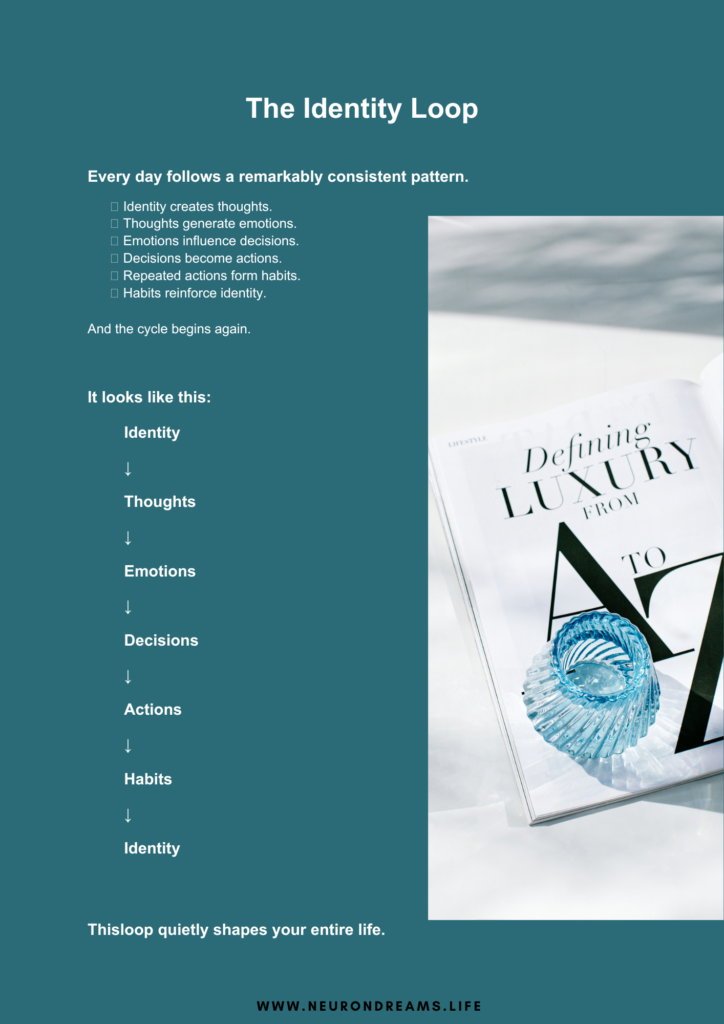
Because every time you create before you consume, you reinforce a new identity:

āš—ļø I am not primarily a consumer of life. I am a creator of it.

šŸœ„ The Daily Win

Your vision must become measurable in daily form.

Not ā€œbe successful.ā€
Not ā€œchange my life.ā€

But:

  • Write 1,500 words

  • Complete the sales page

  • Train for 60 minutes

  • Finish the module

  • Ship the product

  • Do 2 hours of deep work

āš—ļø If it is not measurable, it is not executable.

Define the win.
Protect the win.
Execute the win.

šŸœ The Three-Level Lock-In System

  • Level 1: Non-Negotiable → one action that must happen daily

  • Level 2: Deep Work Block → protected focus window

  • Level 3: Bonus → optional expansion

This structure prevents perfectionism from destroying consistency.

You do not need extraordinary days.

āš—ļø You need consistent direction.

Ā 

šŸœ‚ Measure Output, Not Exhaustion

Busyness is not progress.

Fatigue is not evidence.

Ask instead:

  • What exists today that did not exist yesterday?

  • What was created?

  • What was finished?

  • What moved forward?

Then stop.

Rest is not a reward.

āš—ļø It is part of the system.

🜁 Become Difficult to Distract

Eventually, something changes.

You are no longer someone who tries to focus.

You are someone who protects focus.

Someone who creates before consuming.
Someone who finishes what they start.
Someone who does not negotiate with distraction.

āš—ļø Focus stops being an action.

It becomes identity.

āš—ļø Your Attention Is Your Life in Liquid Form

Your life is not made of years.

It is made of moments of attention.

And every moment you give away unconsciously is a fragment of your life redistributed.

Someone will monetize it.
Someone will use it.
Someone will build from it.

The only question is:

āš—ļø Why shouldn’t it be you?

Your attention is capital.
Your focus is leverage.
Your time is non-refundable.
Your momentum is sacred.

Treat it accordingly.

šŸœ” The 30-Day Lock-In

For the next 30 days:

  • Choose one objective

  • Define one daily action

  • Protect one deep work block

  • Remove digital friction

  • Create before consuming

  • Track execution, not intention

  • Protect sleep and recovery

And when you fail—

Return immediately.

Not tomorrow. Not Monday.

āš—ļø Return.

Again. And again.

Until focus is no longer something you attempt—

but something you are.

šŸœ Final Transmission

The world will continue competing for your attention.

Let it compete.

But do not let it win access.

āš—ļø Your attention is gold.
āš—ļø Your morning is leverage.
āš—ļø Your vision deserves protection.
āš—ļø Your future requires structure.

Before the world gets you—

give yourself to the life you are building.

Lock in.
Protect the signal.
Build the momentum.

āš—ļø Finish what you started.

Ā 

Enter The Flow State Before The World Wakes Up And Steal Your Potential

xo Kate

Remember to SHARE

Pinterest
Facebook
Twitter
LinkedIn
Reddit
Email

Leave a Reply

Your email address will not be published. Required fields are marked *

Welcome

To Neuron Dreams Universe

Hi, I’m Kate — founder of Neuron Dreams Empire.

I believe your identity is your greatest asset.

This is where neuroscience, conscious creation, and the new creator economy come together to help you rewire your mind, regulate your nervous system, build digital assets, and create lasting wealth—from the inside out.

You don’t need a different life.

You need a different identity.

Welcome to Neuron Dreams Empire.

Become the Asset. Create Reality on Your Terms.

Sing Up To Newsletter

You cannot copy content of this page

Don`t copy text!